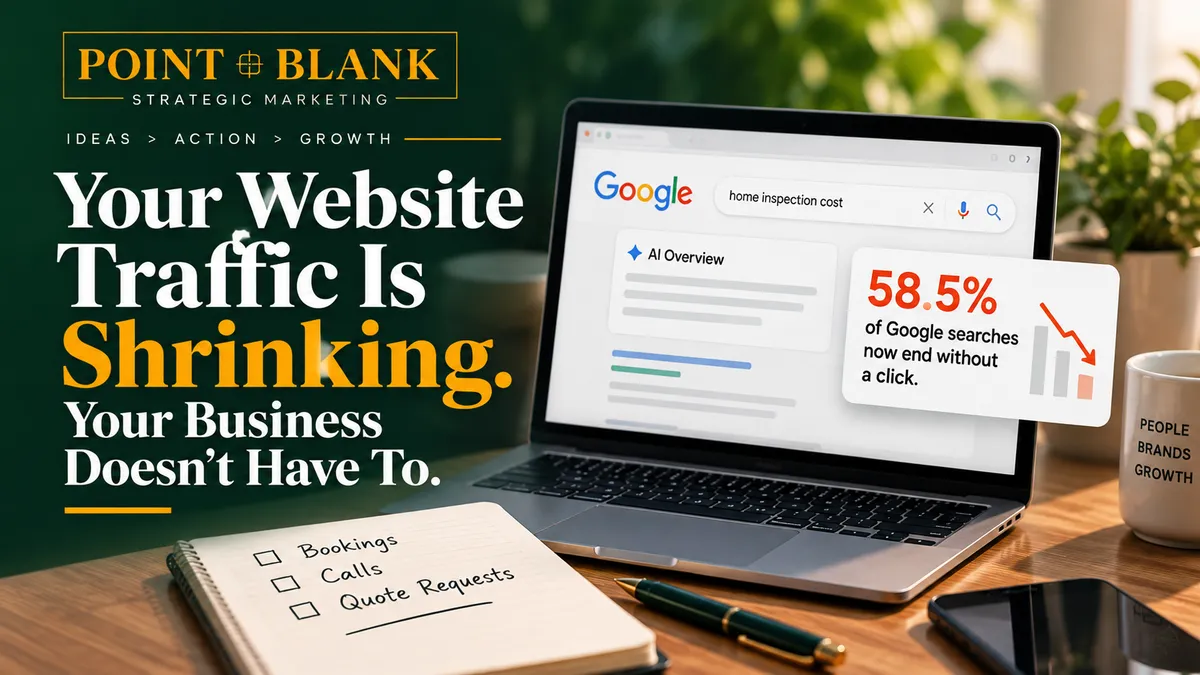
Your Website Traffic Is Shrinking. Your Business Doesn't Have To.
58.5% of Google searches now end without a click. Not to your website. Not to your competitor's. Not to anyone's.
That number comes from a 2024 clickstream analysis by SparkToro and Datos, two firms that track what actually happens after someone types a search into Google. Out of every 1,000 searches, only 360 clicks reach the open web at all. The rest either end the session right there or turn into another search.
If your marketing plan is built around getting people to click through to your site, you're competing for a shrinking piece of a shrinking pie.
This isn't a sign your marketing is broken
Here's the part that matters: this isn't happening because your website is bad or your SEO is weak. It's happening because search itself changed.
Someone Googles "how old is Paul Rudd." Google gives them the age right there on the results page. They got their answer. They close the tab. Nobody needed to click anywhere, and no website "lost" that visitor, because that visitor was never going to visit a website in the first place.
Multiply that by every quick question your customers ask, and you start to see the scale of it. Search engines, social platforms, and AI tools all want the same thing now: keep the answer, and the user, inside their own platform.
What this looks like for your business
Bring this down to your actual situation. Someone searches "how much does a home inspection cost" or "how long does a roof replacement take." Google's AI overview answers the question right on the results page, pulling from whatever information exists out there.
Your business was either part of that answer, or it wasn't.
That's the new game. It's not about ranking number one and hoping for a click anymore. It's about whether your information shows up in the answer at all, on your Google Business Profile, in your reviews, in the way you've written your service pages. If it's not there, the AI answers the question using someone else's information, or nobody's.
The traffic number you're watching might be lying to you
Last year, HubSpot's organic search traffic dropped 80% after Google's algorithm updates and AI overviews rolled out. Eighty percent. That sounds like a catastrophe.
Their revenue hit an all-time high that same quarter.
Traffic and revenue are not the same thing. Traffic was always a stand-in for the number that actually mattered, bookings, calls, quote requests, whatever moves your business forward. It was never the goal itself.
So ask yourself directly: if your website traffic dropped to zero tomorrow, what's the one number you'd actually miss?
Five things to do about it
1. Stop measuring your marketing by traffic alone. Pick the number that matters, bookings, calls, quote requests, and watch that first. If traffic drops but that number holds steady, your marketing is working fine. Your traffic report just stopped being the right report to look at.
2. Publish content that answers the question without needing a click. If people are searching "how much does X cost" or "how long does Y take," write the real answer somewhere Google and AI tools can find it. A clear FAQ page, a direct answer on your Google Business Profile, a pinned post with the actual number. You want to be part of the answer, not just a link nobody clicks.
3. Treat your Google Business Profile like your real homepage. More people see your name, hours, reviews, and photos there than ever reach your actual website. If your profile is thin, outdated, or doesn't answer the questions people actually ask, you're losing them before they ever get to your site.
4. Track branded search volume, not just rankings. If people are searching your business name directly instead of a generic category term, your name is already sticking somewhere before the search happens, a referral, a review, a social post. That's a sign your visibility is working even when nobody clicked anything to get there.
5. Show up consistently in two or three places, not everywhere. You don't need reach on every platform. You need to be the name that keeps showing up while your buyer is circling the decision, even if they never click a link to find you.
The win moved earlier
The click used to be where marketing proved itself. Now the win happens before the click, in the answer someone gets, the name they recognize, the profile that already told them what they needed to know.
So the real question isn't whether your traffic is dropping. It probably is. The question is whether your business shows up in the moment before the click even happens.
What's the one number you'd actually miss if your traffic disappeared tomorrow?
Want to know where your business actually stands? Book a call and we'll walk through it together.


